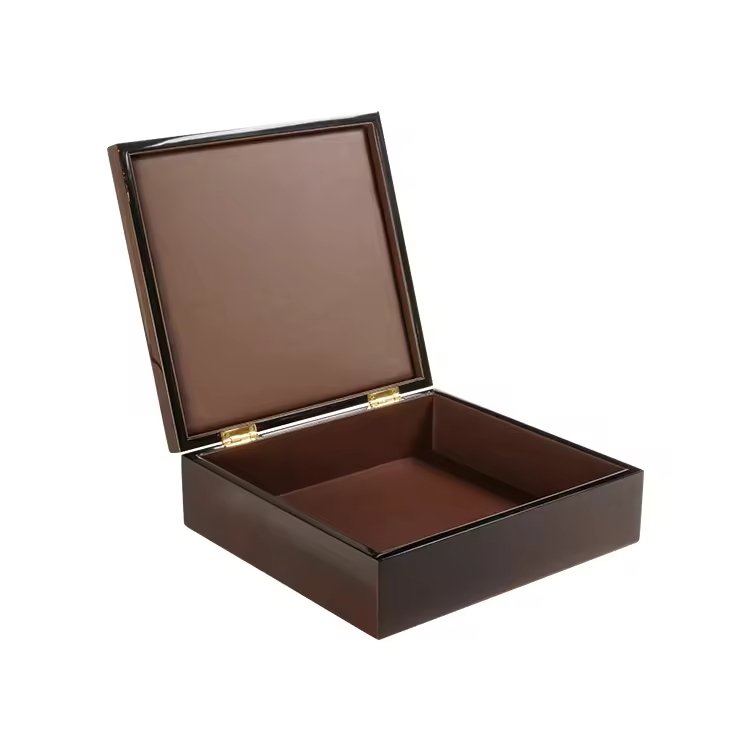
You want custom shapes. You want special finishes. But you also need stable quality and controlled cost.
MDF wooden boxes offer the best balance between structural stability, finishing flexibility, and production efficiency, which makes them the most cost-effective solution for most custom packaging projects.
In our factory, more than 70% of custom wooden boxes use MDF as the core material. This is not because it is the cheapest option. It is because it gives the most predictable and stable long-term result.
Why MDF Is the Most Common Core Material in Custom Wooden Boxes
Some clients assume solid wood is always better. But in real production, MDF is the most widely used core material.
MDF is the most common core material because it provides consistent density, flat panels, and predictable performance, which makes it ideal for custom wooden box structures.
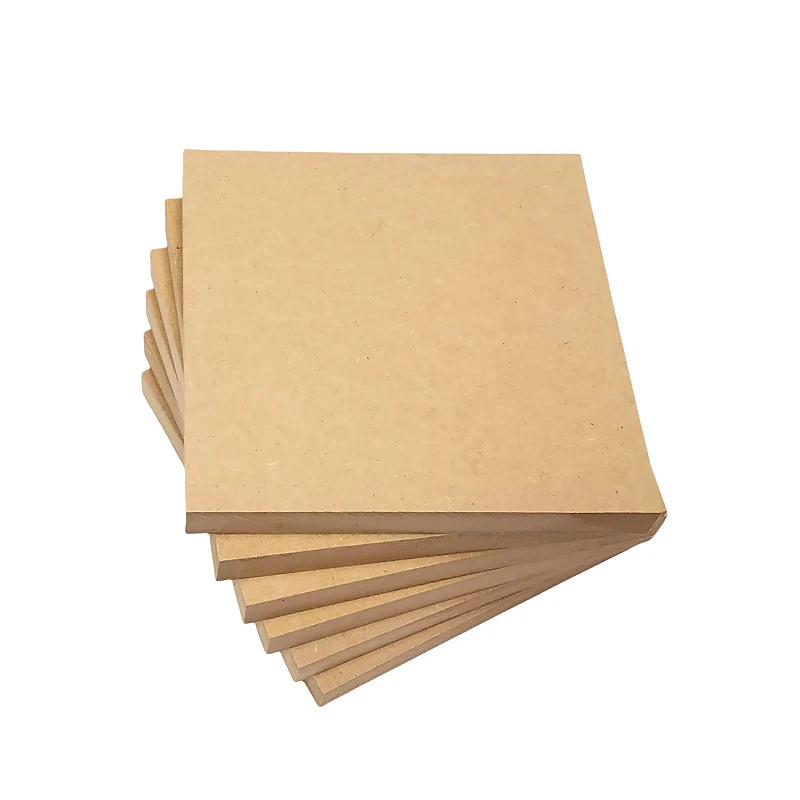
MDF stands for Medium Density Fiberboard. It is an engineered board made from wood fibers compressed under heat and pressure. The internal structure is uniform. There are no knots. There are no hidden cracks.
Consistent Density and Flatness
The biggest advantage is consistency.
Every MDF board:
- Has even density.
- Stays flat under normal conditions.
- Has no natural grain direction.
This means when we cut panels, the results are stable and repeatable. For custom projects, repeatability is very important.
With solid wood, grain direction affects strength and movement. With MDF, structure behaves the same in every direction.
Ideal for Custom Shapes
When clients request:
- Curved edges
- Angled cuts
- Multi-layer structures
- Thick walls for heavy products
MDF performs very well. It cuts cleanly. It bonds well with glue. It keeps sharp angles without splitting.
In custom packaging, structure is more important than raw material story. If the box shape is complex, MDF usually gives fewer production problems.
Export-Friendly Performance
Many of our projects ship to:
- The USA
- أوروبا
- الشرق الأوسط
During sea freight, containers experience humidity changes. MDF is much more predictable than solid wood under these conditions. That is why it is widely used in export packaging.
Structural Stability: Why MDF Is Easier to Control
You want your box to look perfect not only today, but also months after delivery.
MDF offers better dimensional stability than solid wood because it does not expand or shrink significantly with humidity changes, which reduces warping and cracking risks.
From my experience, stability is one of the most underestimated factors in packaging.
No Natural Grain Movement
Solid wood moves because it absorbs moisture from air. MDF is engineered. Its fibers are bonded evenly. It does not have directional grain.
This leads to:
- Lower expansion and contraction
- Less panel warping
- More stable lid alignment
For export projects, this matters a lot.
Tolerance Control
In our factory, we usually control fitting tolerance within ±1mm for:
- Lid closing alignment
- Insert matching
- Drawer sliding fit
MDF allows this level of control more easily.
Here is a comparison:
| Stability Factor | MDF | خشب صلب |
|---|---|---|
| Humidity Movement | منخفضة | Medium to High |
| Warping Risk | منخفضة | متوسط |
| Crack Risk | منخفضة جداً | ممكن |
| Tolerance Control | أسهل | More Complex |
After-Sales Risk Reduction
After-sales issues cost time and reputation. If a box arrives with slight deformation, even if the product inside is fine, the brand image suffers.
MDF reduces this risk significantly.
For long-distance shipping and multi-climate markets, I often recommend MDF simply for peace of mind.
Surface Finishing Flexibility: Veneer, Painting, and Special Effects
You may not care about core material. You care about how the box looks and feels.
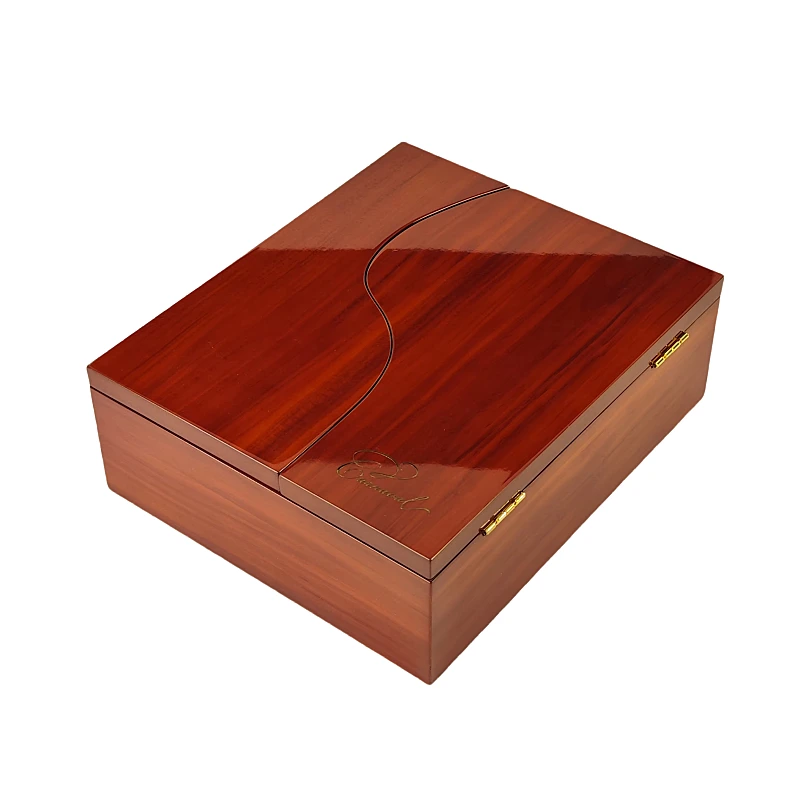
MDF supports a wide range of surface finishes, including high-gloss lacquer, matte PU coating, wood veneer lamination, and special texture effects, often with better edge precision than solid wood.
Surface finishing is where MDF truly shines.
High-Gloss and Piano Finish
If you want:
- Deep black piano finish
- Mirror-like glossy surface
- Perfect edge reflection
MDF performs better than solid wood.
Its smooth surface allows even coating layers. Edges stay sharp. Reflection lines look straight and clean.
Veneer Lamination
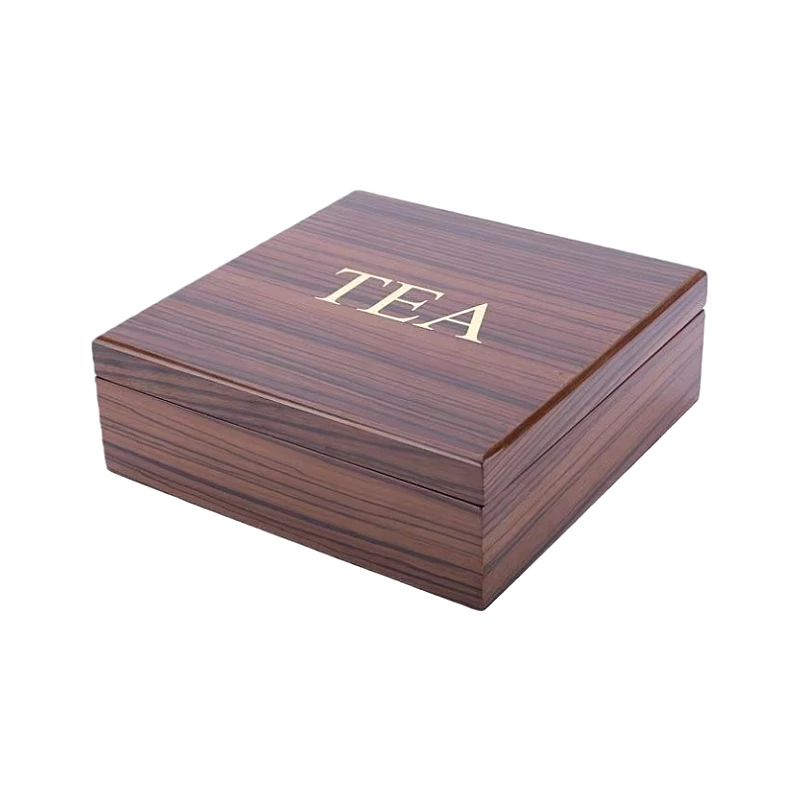
If you still want natural wood appearance, we can laminate real wood veneer onto MDF.
This gives:
- Real wood grain on the surface
- Stable MDF structure inside
- Better cost control
In many cases, customers cannot visually tell the difference between solid wood and veneered MDF.
Special Effects and Colors
MDF also works well with:
- Matte rubberized coatings
- Metallic paint
- Soft-touch finishes
- Textured spray effects
Because the surface is consistent, color absorption is even. That improves final quality.
Precision at Edges and Corners
Edge alignment is critical in premium boxes.
MDF:
- Holds 90-degree angles well.
- Allows precise corner finishing.
- Supports hidden hinges and magnet embedding easily.
For complex custom shapes, this precision makes production smoother.
Cost Control and Production Efficiency Advantages
You need good quality. But you also need sustainable margins.
MDF reduces material waste, shortens production time, and lowers overall unit cost, especially for medium volumes between 500 and 3000 pieces.
Cost efficiency is not about choosing the cheapest material. It is about balancing quality and production stability.
Lower Material Waste
MDF sheets are manufactured in standard sizes. Cutting plans are optimized. Waste ratio is low and predictable.
Solid wood planks:
- May have unusable sections.
- Require more sorting.
- Create higher yield loss.
Lower waste means better cost control.
Faster Production Cycle
MDF:
- Is easier to cut and assemble.
- Requires less sanding time.
- Has fewer moisture conditioning steps.
This often reduces lead time compared to solid wood.
For projects with tight schedules, this advantage is important.
Best Balance for Medium Volumes
From my experience:
| كمية الطلب | أفضل اختيار المواد |
|---|---|
| Below 300 pcs | Depends on positioning |
| 500–3000 pcs | MDF is ideal |
| Large stable volume | MDF or hybrid structure |
For medium volumes, MDF offers:
- جودة ثابتة
- Controlled cost
- Predictable delivery time
That combination is difficult to beat.
When MDF Is the Smartest Choice for Your Project
You may ask: if MDF is so practical, when exactly should I choose it?
MDF is the smartest choice when your priority is custom structure, special surface finishing, export stability, and cost control rather than natural material storytelling.
After many years in this industry, I look at four main factors.
Choose MDF When:
- Your design includes complex shapes.
- You want high-gloss or deep lacquer finish.
- Your shipment goes overseas.
- Your budget needs careful control.
- Your order volume is medium to large.
- You want low after-sales risk.
Consider Other Options When:
- Your brand story strongly emphasizes solid natural material.
- The box itself is marketed as a collectible wooden item.
- Your retail price easily absorbs higher packaging cost.
Practical Business View
MDF may not sound as “premium” as solid wood. But in real business terms, stability builds trust.
Customers rarely ask about core material. They care about:
- How the box looks.
- How it feels.
- Whether it stays in good condition over time.
If MDF delivers:
- Clean appearance
- Stable structure
- Competitive cost
Then it often becomes the smarter long-term decision.
For many custom design projects, I recommend MDF not because it is cheaper, but because it gives the best balance between beauty, reliability, and profit protection.
الخاتمة
MDF wooden boxes provide stability, finishing flexibility, and strong cost control, making them the most practical and cost-effective choice for most custom packaging projects.
WoodoBox - Premium Wooden Packaging Manufacturer in China
صناديق خشبية مصممة حسب الطلب، مصنوعة بإتقان

 العربية
  English
  Español
  Português
  Deutsch
  Français
  Italiano